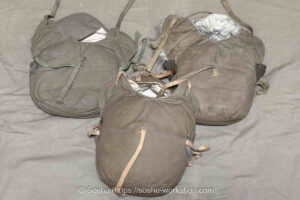
This time, I will introduce the Accessory Bag used to store the Type 100 Anti-Gas Gaiters (Otsu) for military horses. In Japanese, the gaiters are called 一〇〇式防毒脚絆(乙), and the bag is called 属品袋 (Zokuhin-bukuro).
The Type 100 Anti-Gas Gaiters (Otsu) were intended to protect the lower legs of military horses from blister agents. They came in two sizes, large and small: the large size was specified for horses with horseshoe size No. 5 or larger, and the small size for those with No. 3 or smaller. For horses with size No. 4 horseshoes, large and small gaiters were issued half and half.
For details on the Type 100 Anti-Gas Gaiters (Otsu), two documents are particularly informative: “Provisional Standard for the Type 100 Anti-Gas Gaiters (Otsu)”1 and “Provisional Handling Instructions for the Type 100 Anti-Gas Gaiters (Otsu)”2.
The one shown here is the Accessory Bag for the large size. It holds four gaiters in total, two for the left legs and two for the right. Two fastening cords, including a spare, come with it.
The piece introduced here was obtained in 2025 at an auction where the holdings of a major collector were released. The large and small Anti-Gas Gaiters that had been stored inside, as well as an Accessory Bag for the small size, were listed as separate lots, but this bag had found its way into a group of items that I won separately. A huge number of items were put up for sale, so it was probably mixed in when the organizer sorted them into boxes.
According to the “Provisional Standard”, the dimensions are 250 mm in height, 175 mm in width, and 100 mm in thickness, and the actual piece is roughly as specified. Note that the rubber itself has hardened, and the bag has set in this shape.
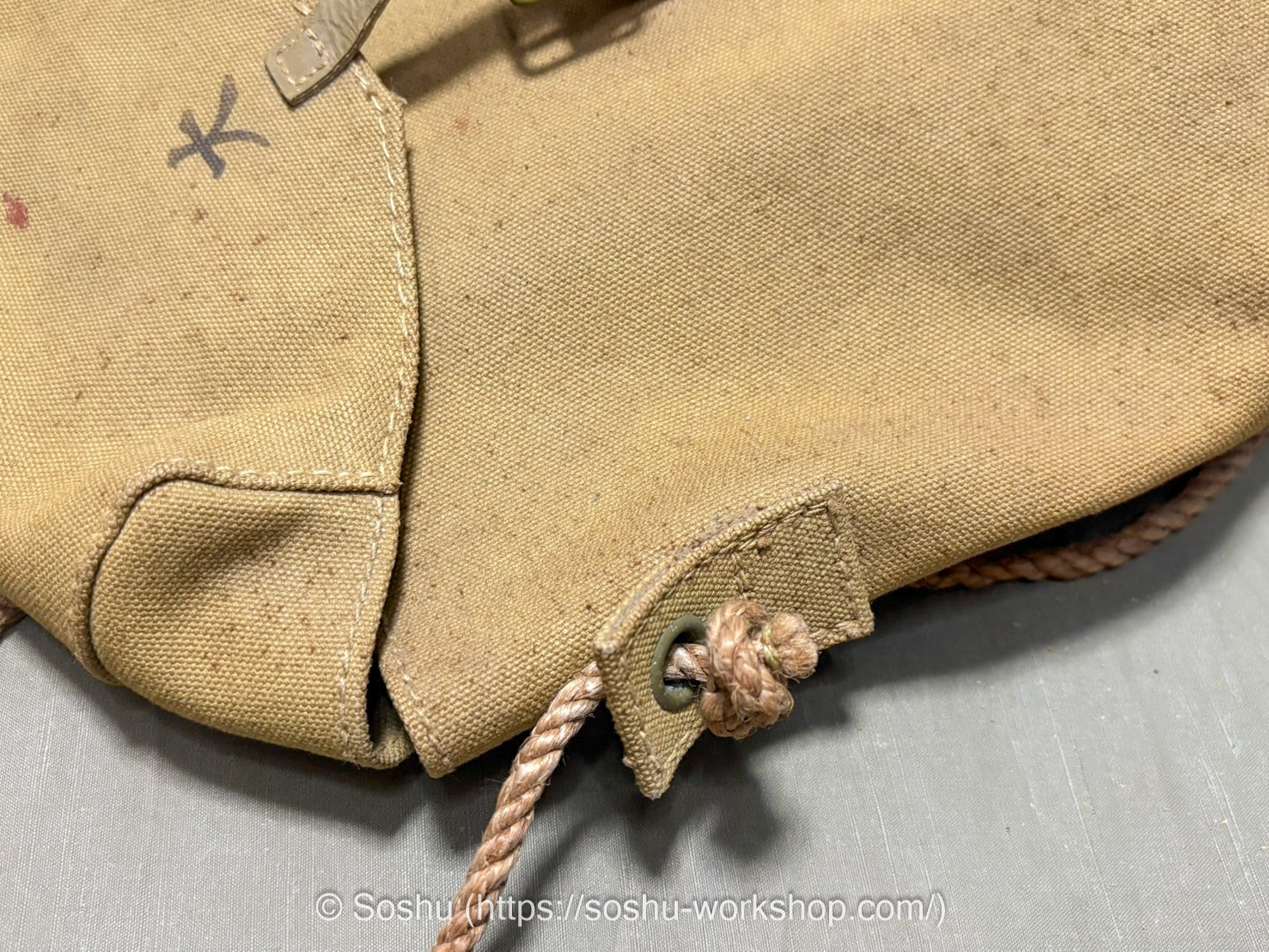
The three loops on the back are called “駐布” (Chūfu); when attaching the bag to horse tack or a vehicle, a cord is passed through them to secure it. As a rule, the bag was attached to the horse tack so that the Anti-Gas Gaiters could be put on right away, but depending on the situation it was loaded onto the nearest vehicle for transport. For riding horses, the documents state that it was attached just in front of the right saddlebag.
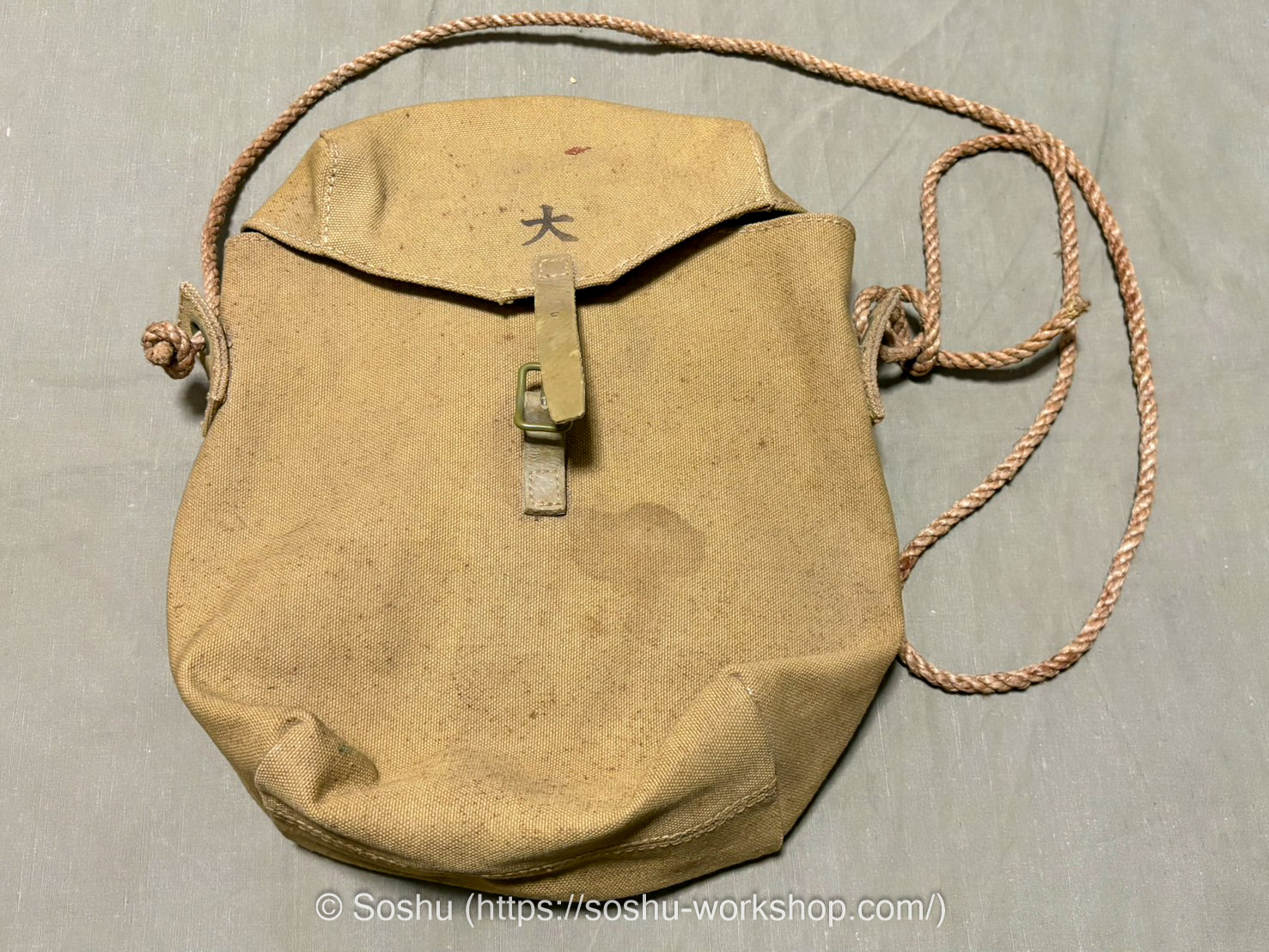
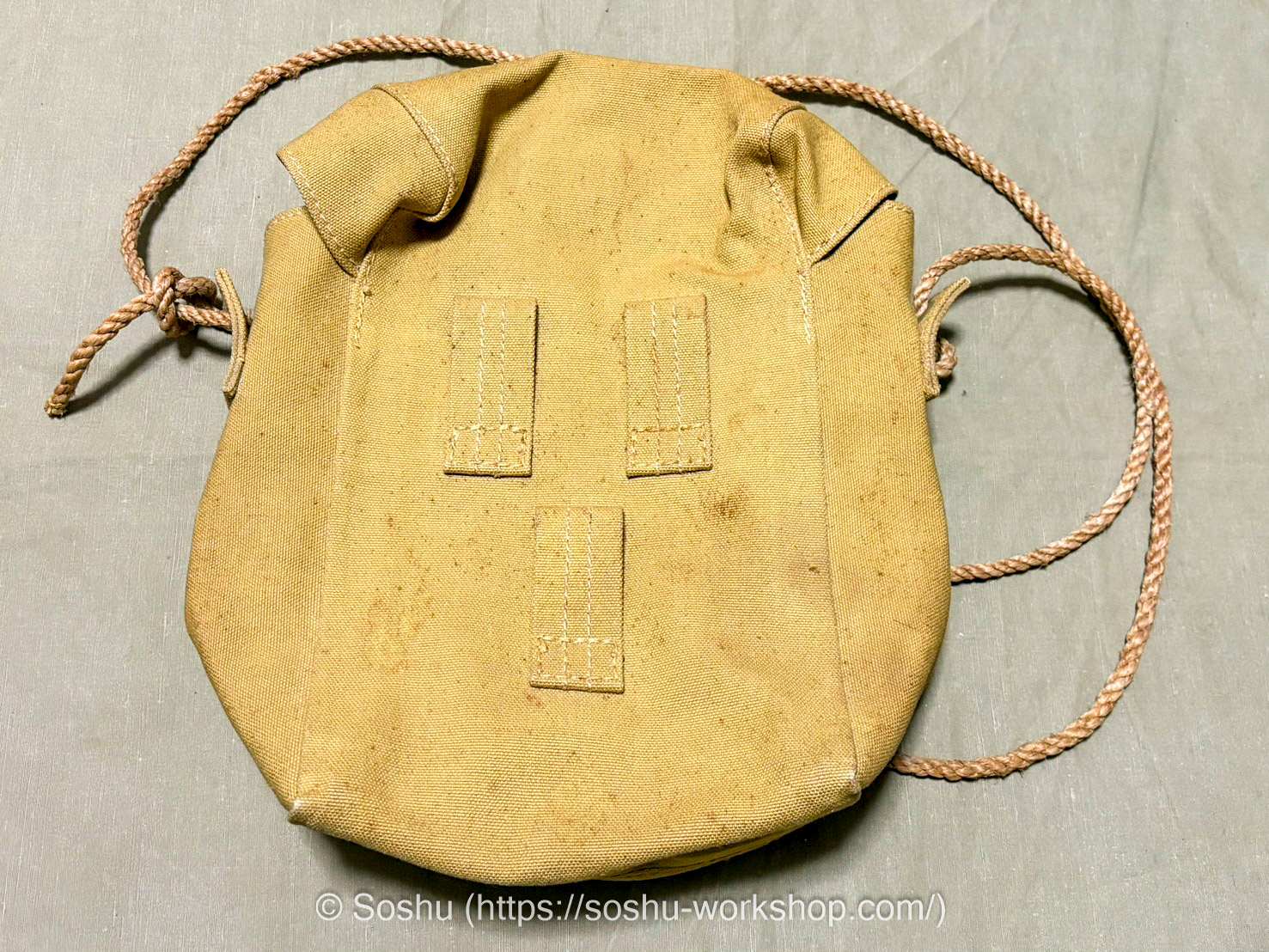
According to the “Provisional Standard”, the cord is a round cotton cord 1,550 mm long and 5 mm in diameter. The actual piece is roughly as specified, though the cord is slightly shorter. The right side is tied in a knot, which seems to allow the length to be adjusted.
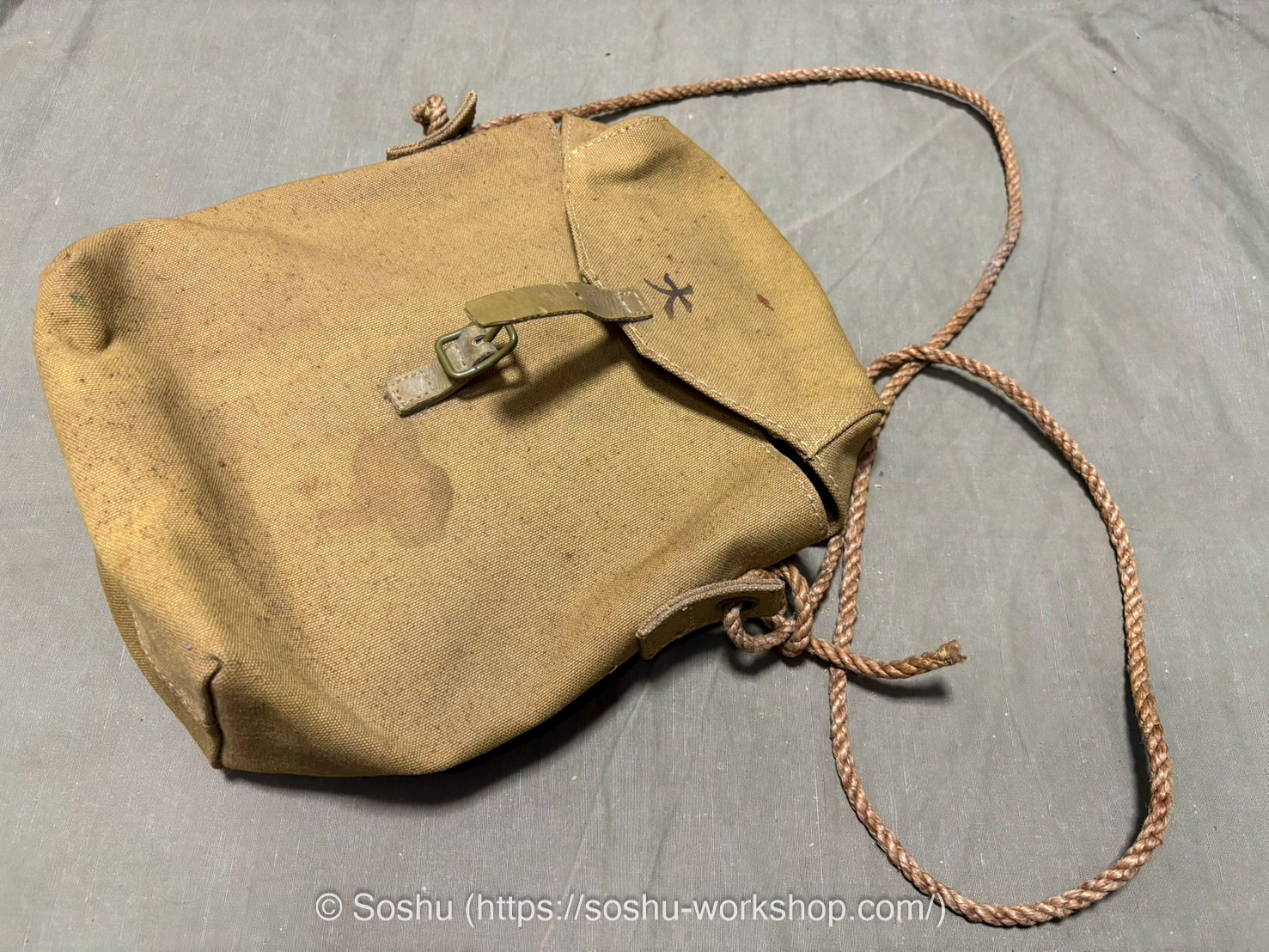
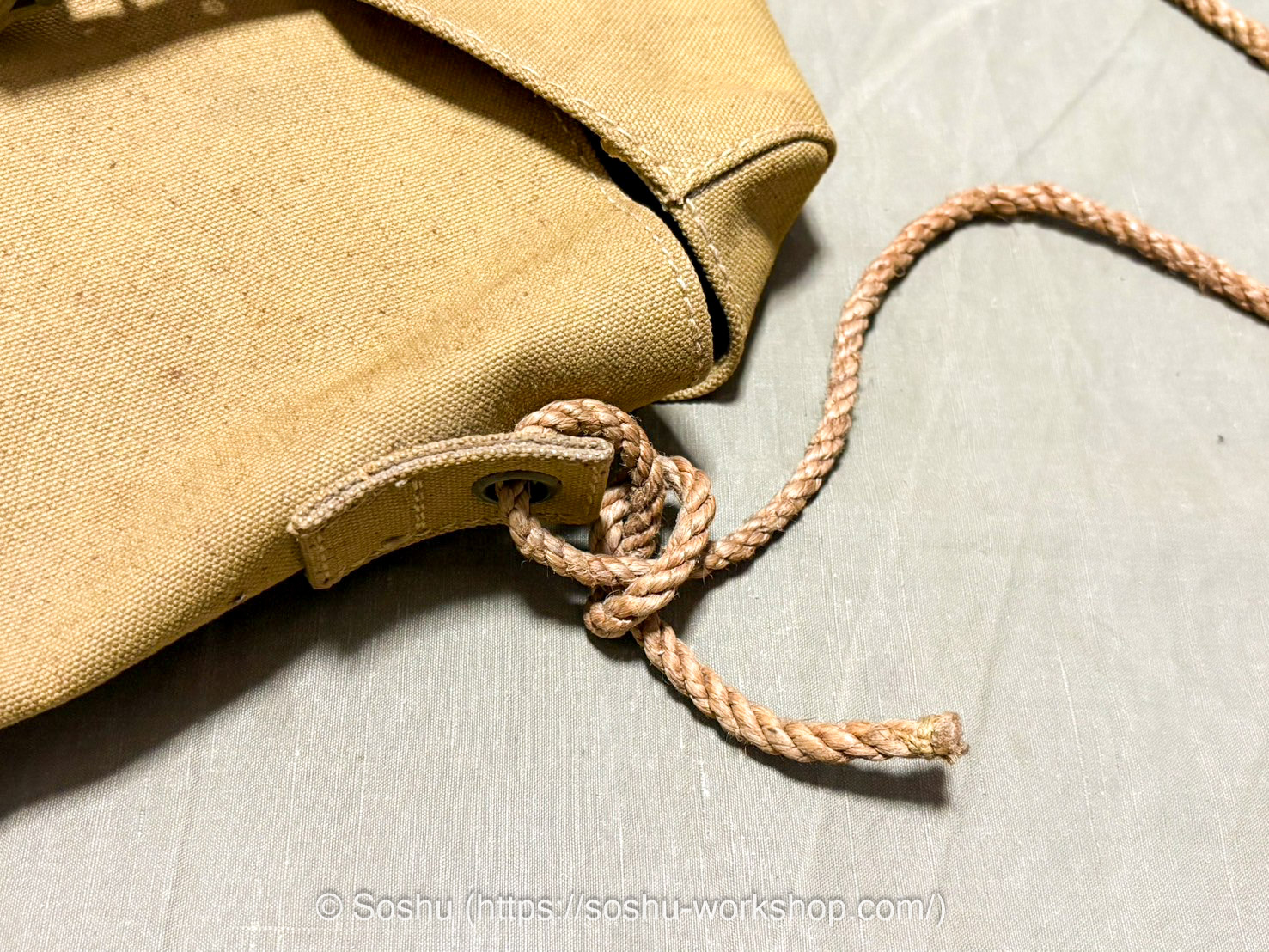
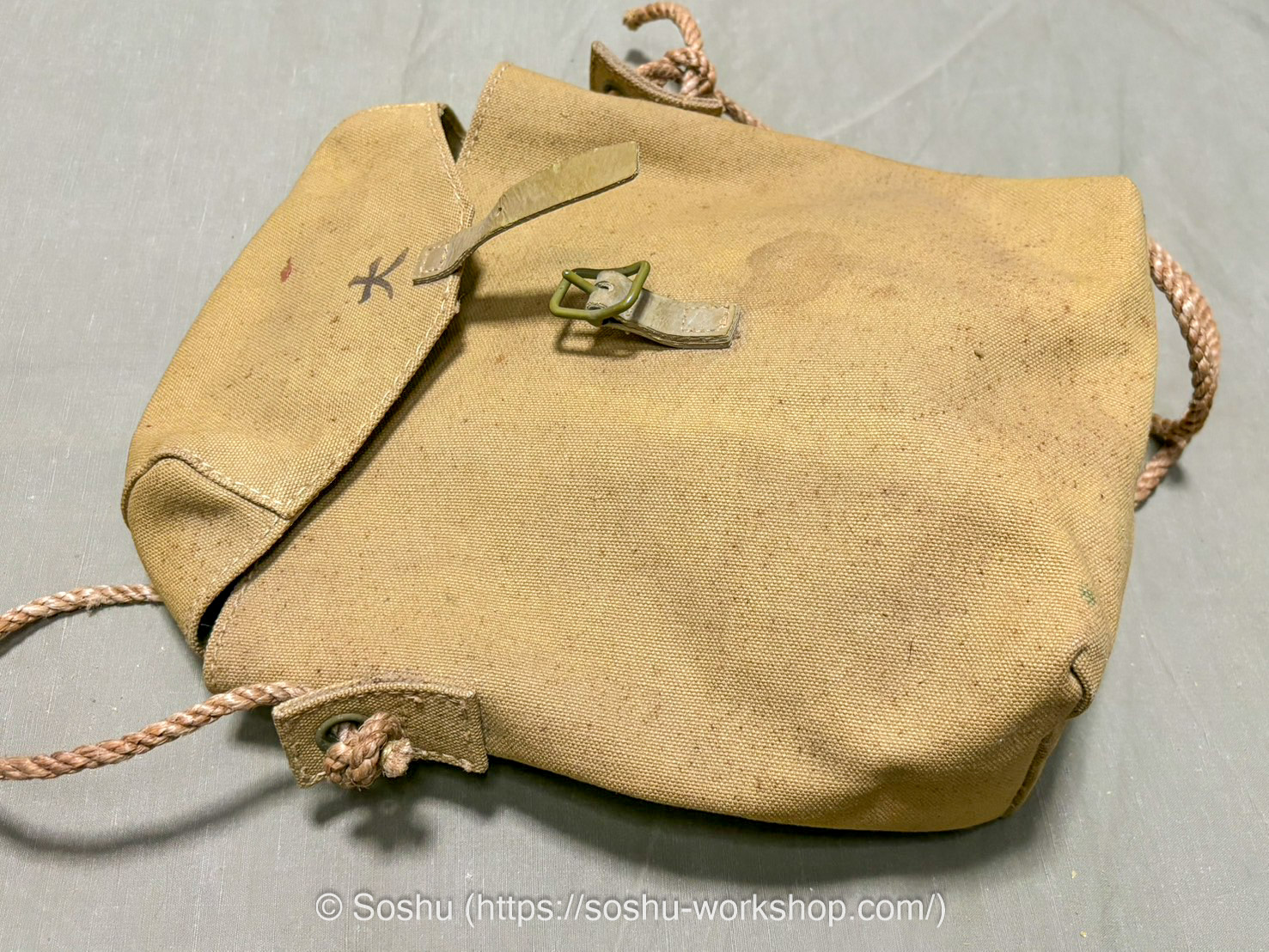
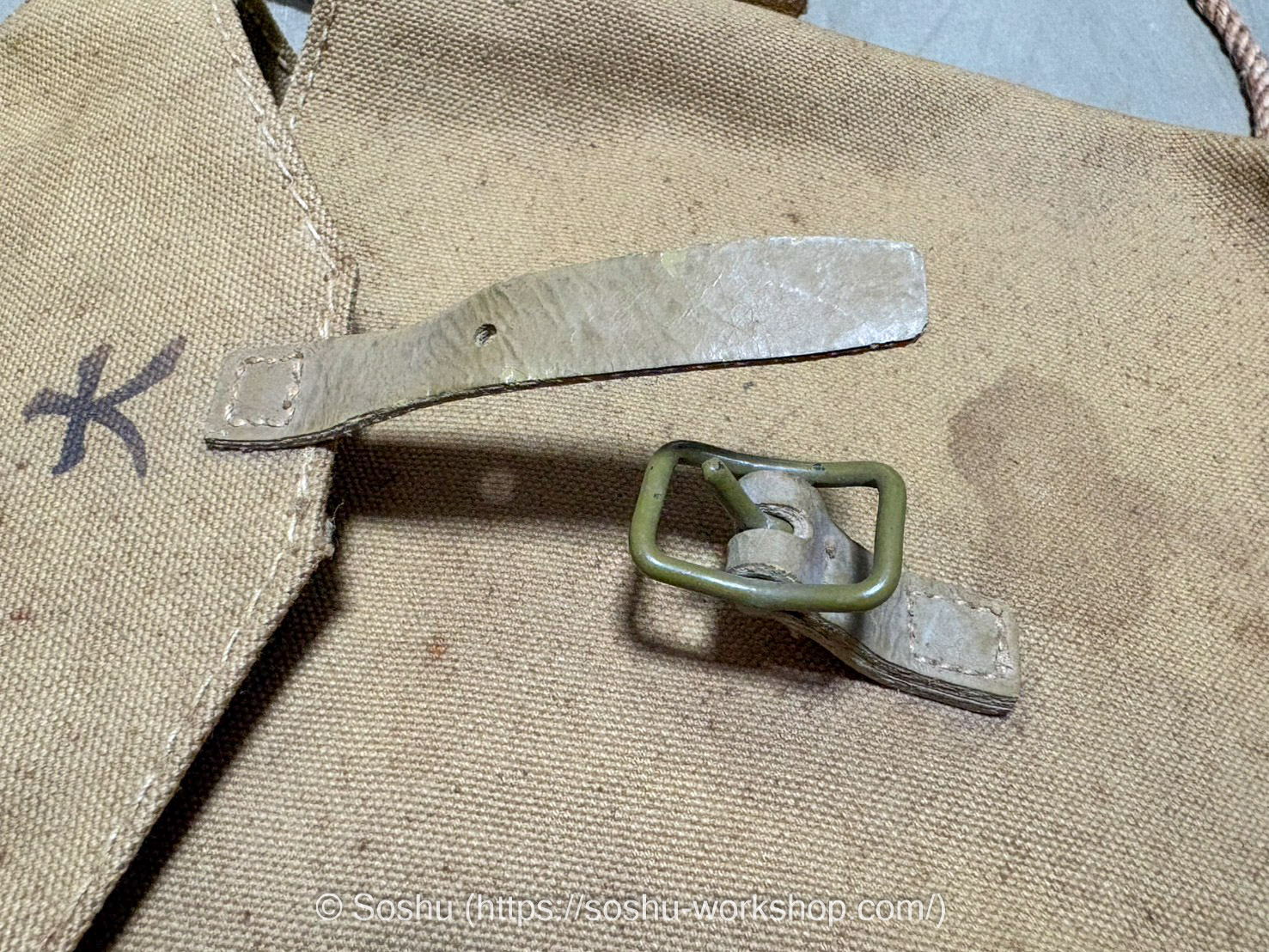
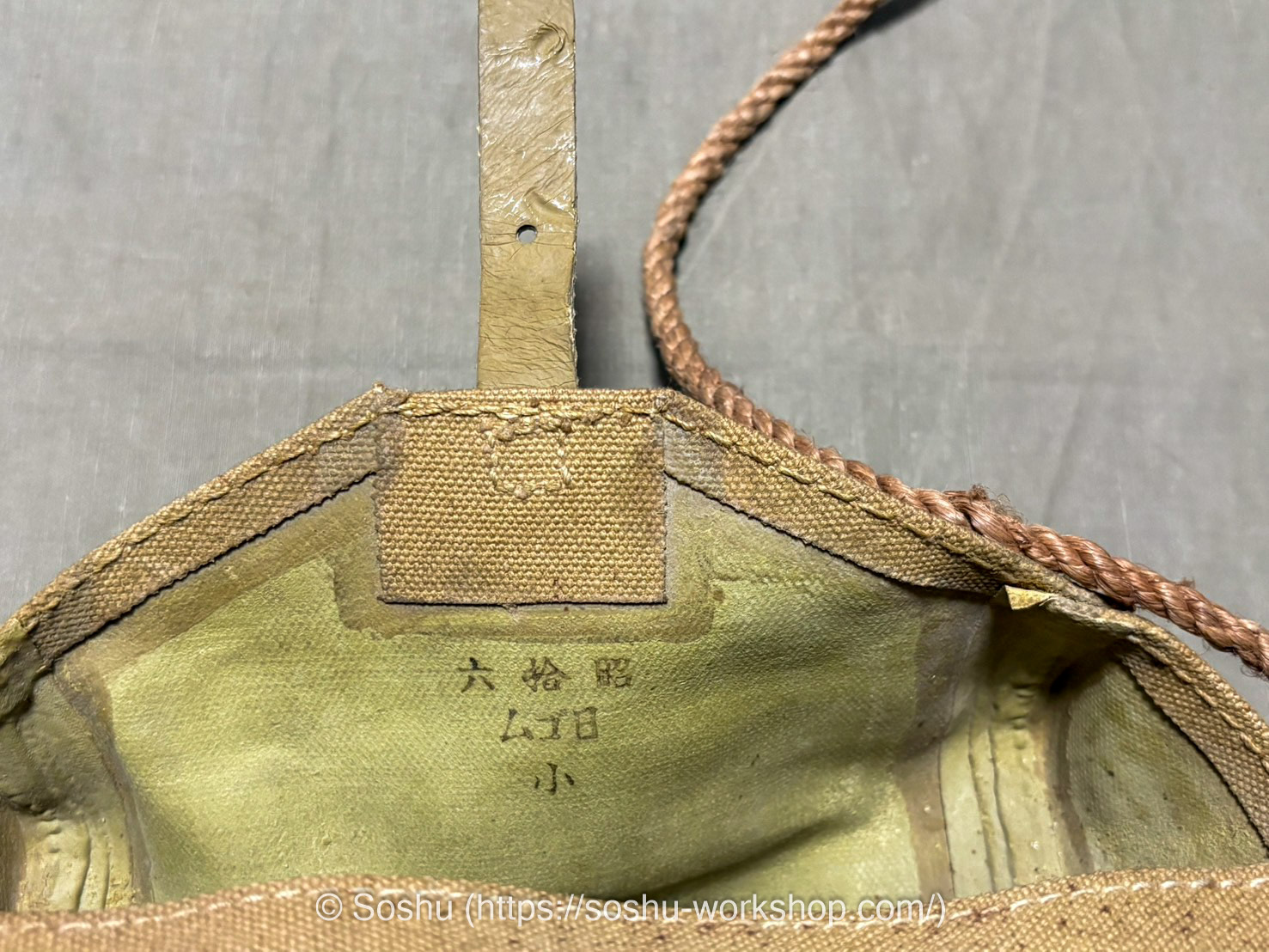
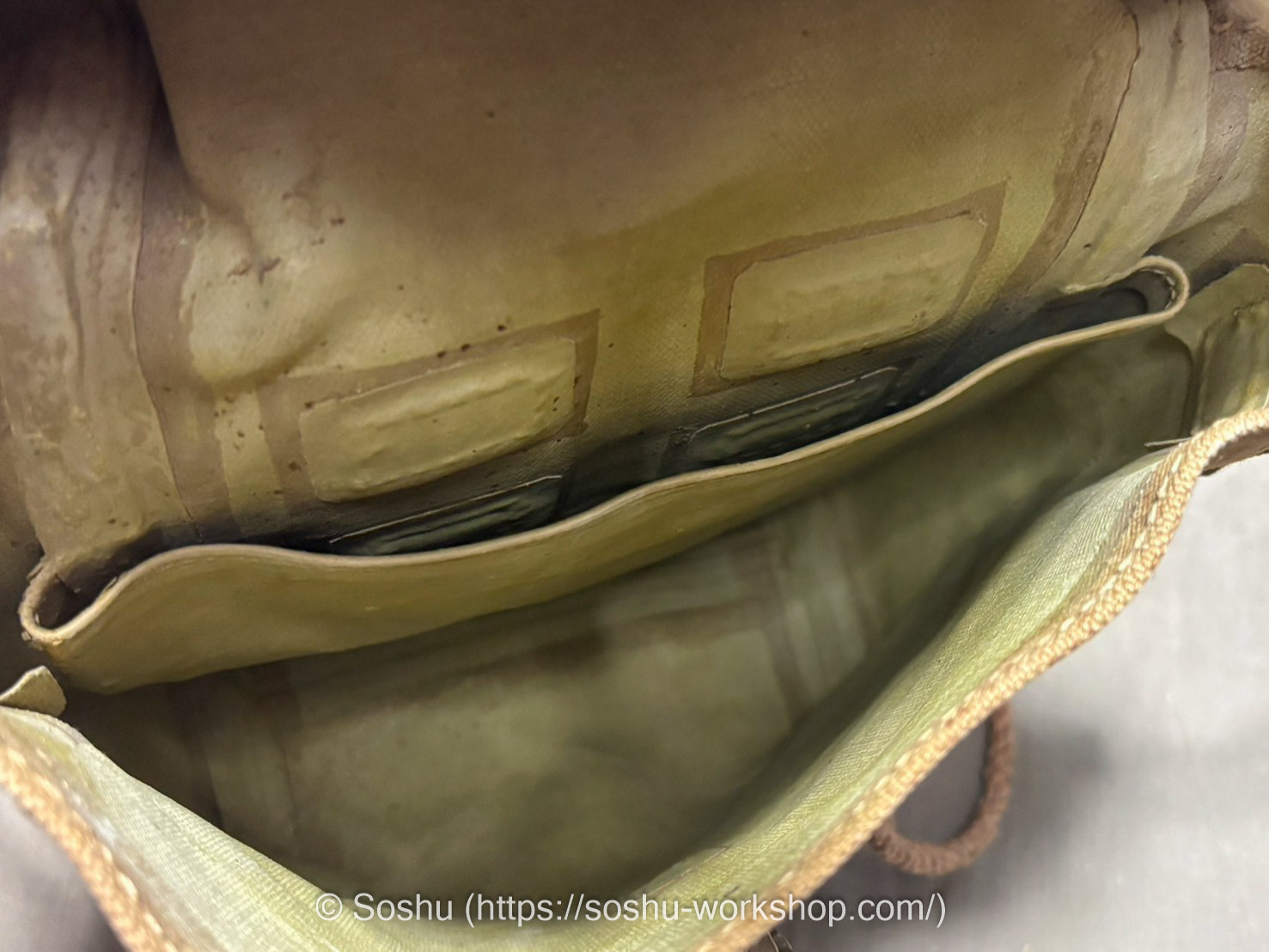
Here the buckles are undone and the flap is open. Inside is the marking “昭16 日ゴム 小” (Shōwa 16 [1941], Nichi-Gomu, Small). As the “大” (large) marked on the outside of the top flap indicates, I believe this is the Accessory Bag for the large size, so I am not sure why it says “小” (small).
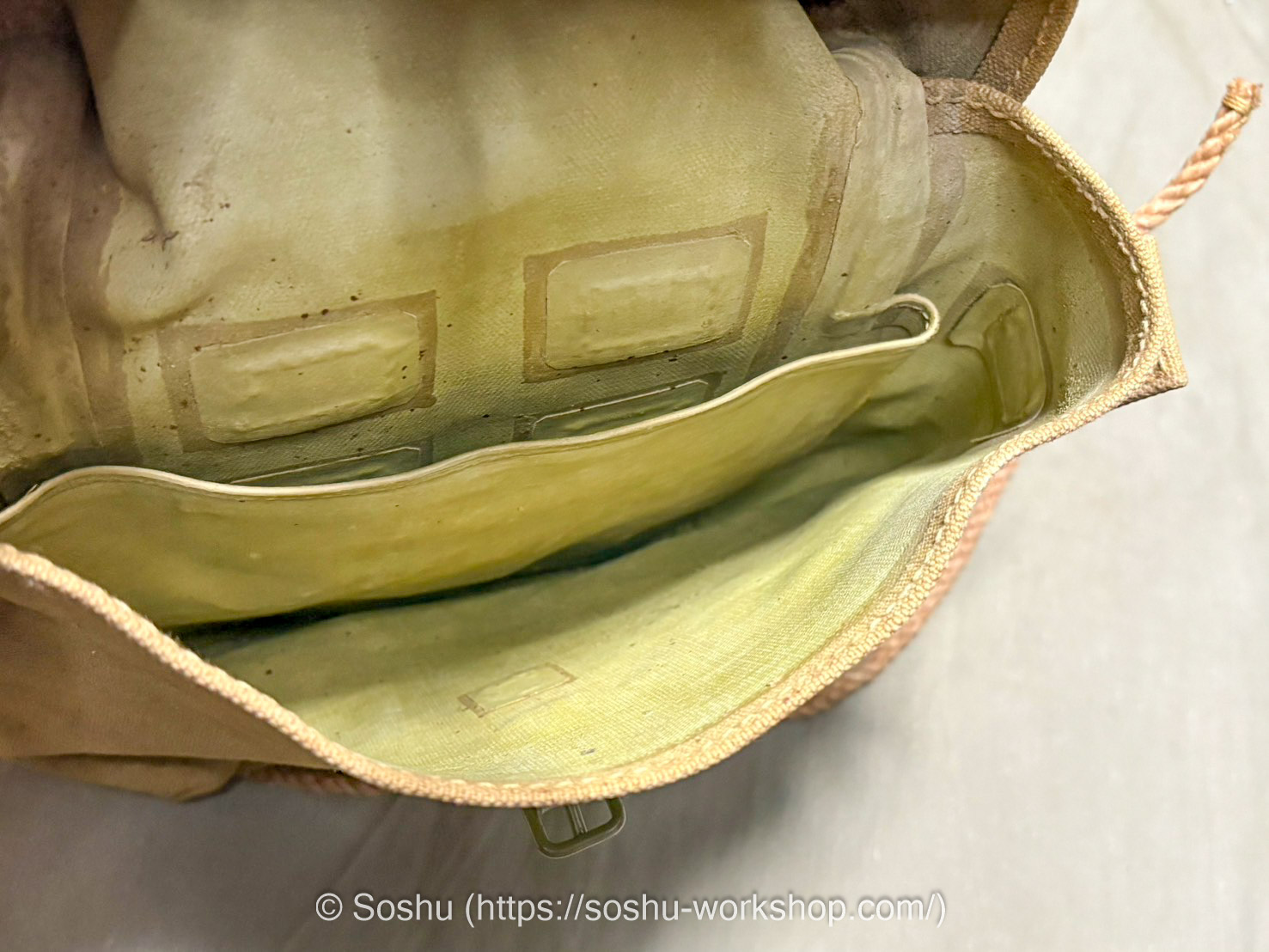
There is a partition inside. According to the “Provisional Handling Instructions”, the spare fastening cord was to be kept in this small compartment.
Footnotes
- “Temporary standard of anti-gas gaiters Model 100 (Type B (otu) )” JACAR (Japan Center for Asian Historical Records), Ref.C01005259800, from July 1941 onward, “Army General Affairs (China-Manchuria-Asia) Confidential File, Unit No. 9951” (National Institute for Defense Studies) ↩︎
- “Temporary operation manual for anti-gas gaiters Model 100 (Type B (otu) )” JACAR (Japan Center for Asian Historical Records), Ref.C01005279200, 1942, “Army General Affairs File, Records Office” (National Institute for Defense Studies) ↩︎