The Cold Weather Mittens are winter garments classified under the Special Regional Clothing category, intended for use in extremely cold regions. They were worn together with equipment such as the Cold Weather Coat and Cold Weather Cap.
There are several variations of the Cold Weather Mittens. In 1929 (Shōwa 4), with the issuance of “Regarding the Regulations for Special Regional Clothing”1, Cold Weather Mittens for Motor Vehicle Operation are illustrated. Later, in the 1938 (Showa 13) “Revisions to the Army Uniform and Equipment Regulations under Article 5 of the Army Uniform Regulations”2, Cold Weather Mittens for Work Use and Cold Weather Mittens for Signal Personnel are listed.
The main differences that can be identified from the drawings are as follows:
- Cold Weather Mittens
- These are mitten-type gloves with a separate compartment for the index finger. They are normally worn as mittens, but when necessary, the index finger can be inserted into the separate finger section, allowing both the thumb and index finger to move freely. This design was likely intended for actions requiring use of the index finger, such as firing a rifle.
- Cold Weather Mittens for Motor Vehicle Operation
- These are also mitten-type gloves, but only the right hand has a separate index finger compartment. Since this type does not appear in the 1938 revision documents, it may have been discontinued on the grounds that the standard Cold Weather Mittens were sufficient as a substitute. With the standard type, both index fingers can be used freely, so there would likely have been no particular operational disadvantage.
- Cold Weather Mittens for Work Use
- This type has a separated index finger structure, forming a three-part configuration: thumb, index finger, and the remaining fingers together. It is said to have been used primarily by tank crew members. In my personal view, if the index finger section were left hanging unused during work, it could risk being caught or entangled in machinery. This may have been the reason for adopting this structure.
- Cold Weather Mittens for Signal Personnel
- The signal personnel type is a full five-finger glove. Since operating communications equipment requires precise finger movements, it is only natural that this form was adopted.
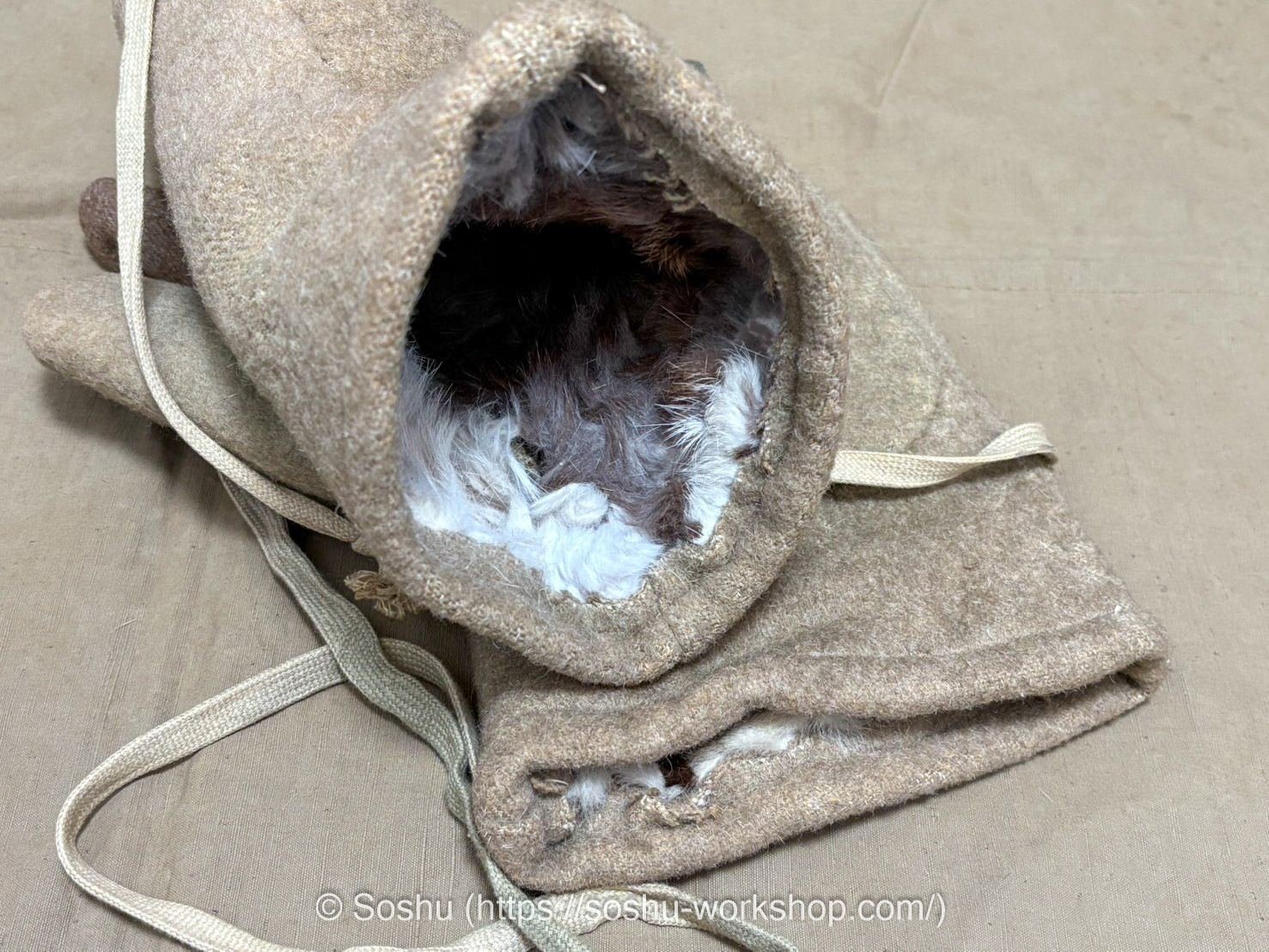
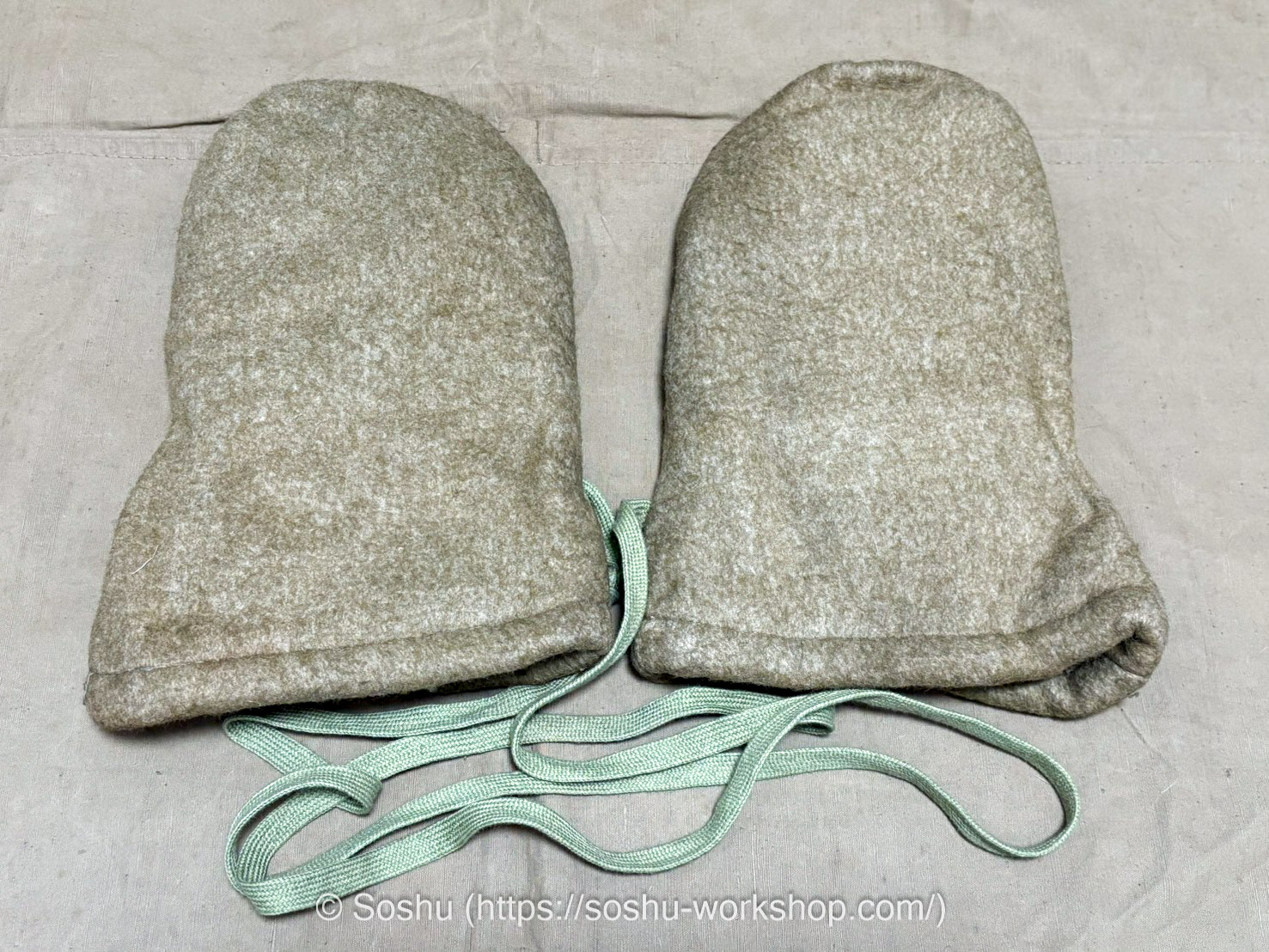
Authentic examples of the Cold Weather Mittens are shown below. There appear to be individual variations in texture and color, and several different specifications seem to exist. None of the examples I have examined bear an inspection stamp, nor could I find any size markings. Judging from the dimensions, it is possible that they were issued in a single, relatively large size.
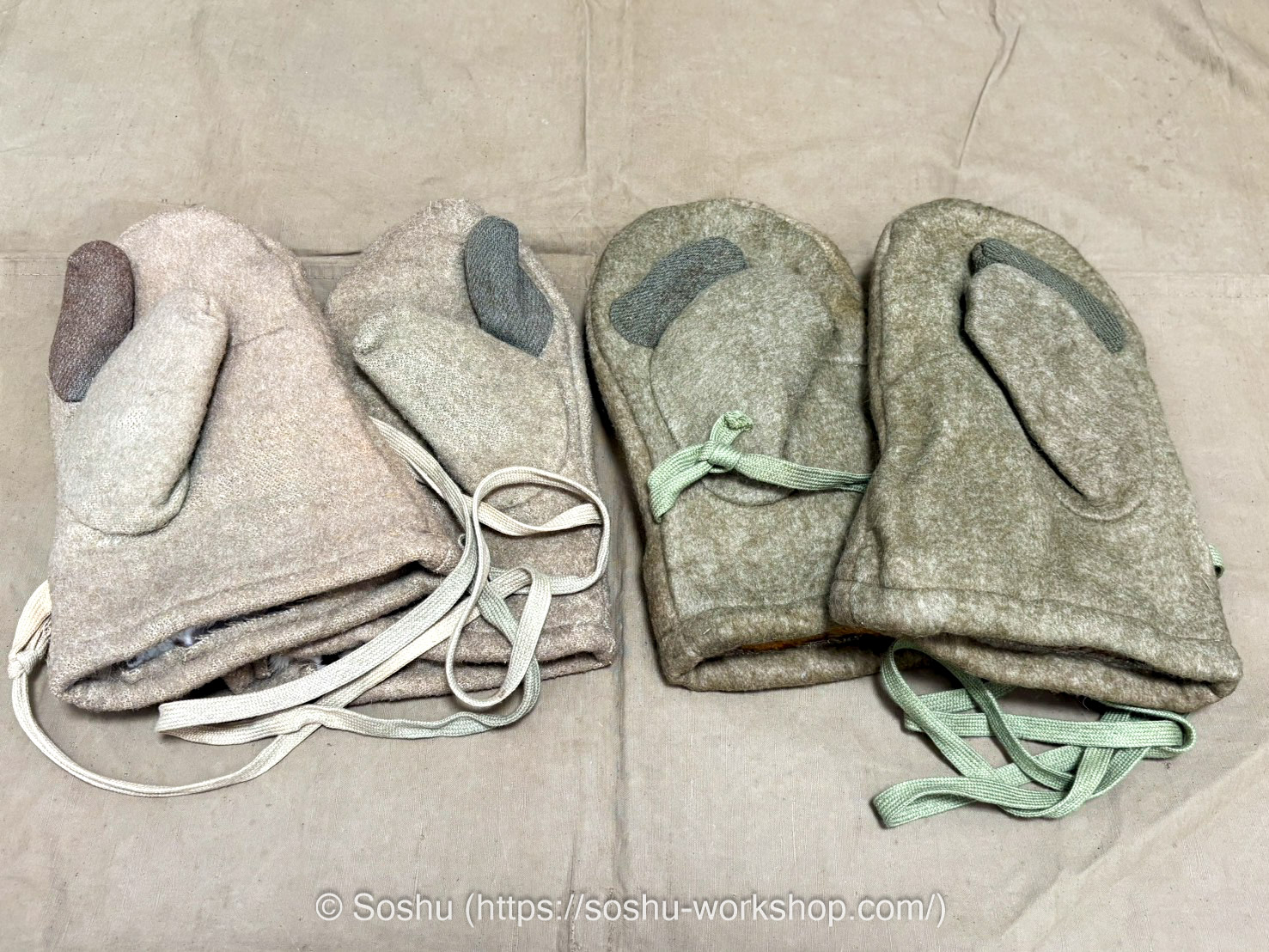
The Cold Weather Mittens are fitted with a long cord connecting the left and right gloves. By passing this cord through loops located near the shoulders of the Cold Weather Coat, the mittens are secured in a way that prevents them from being lost. The version for motor vehicle operation is equipped with a similar cord, but it appears that the other types did not include this feature.
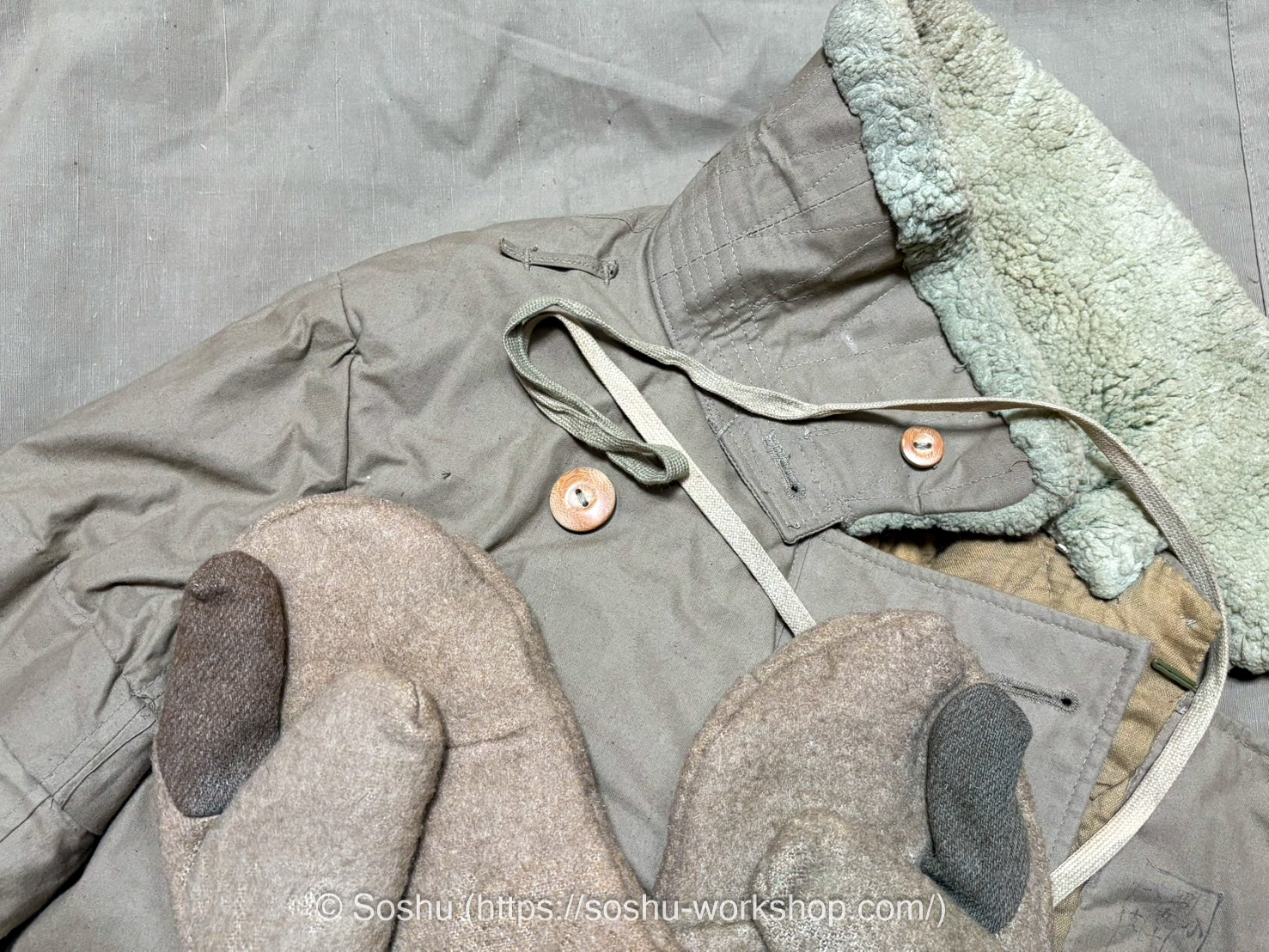
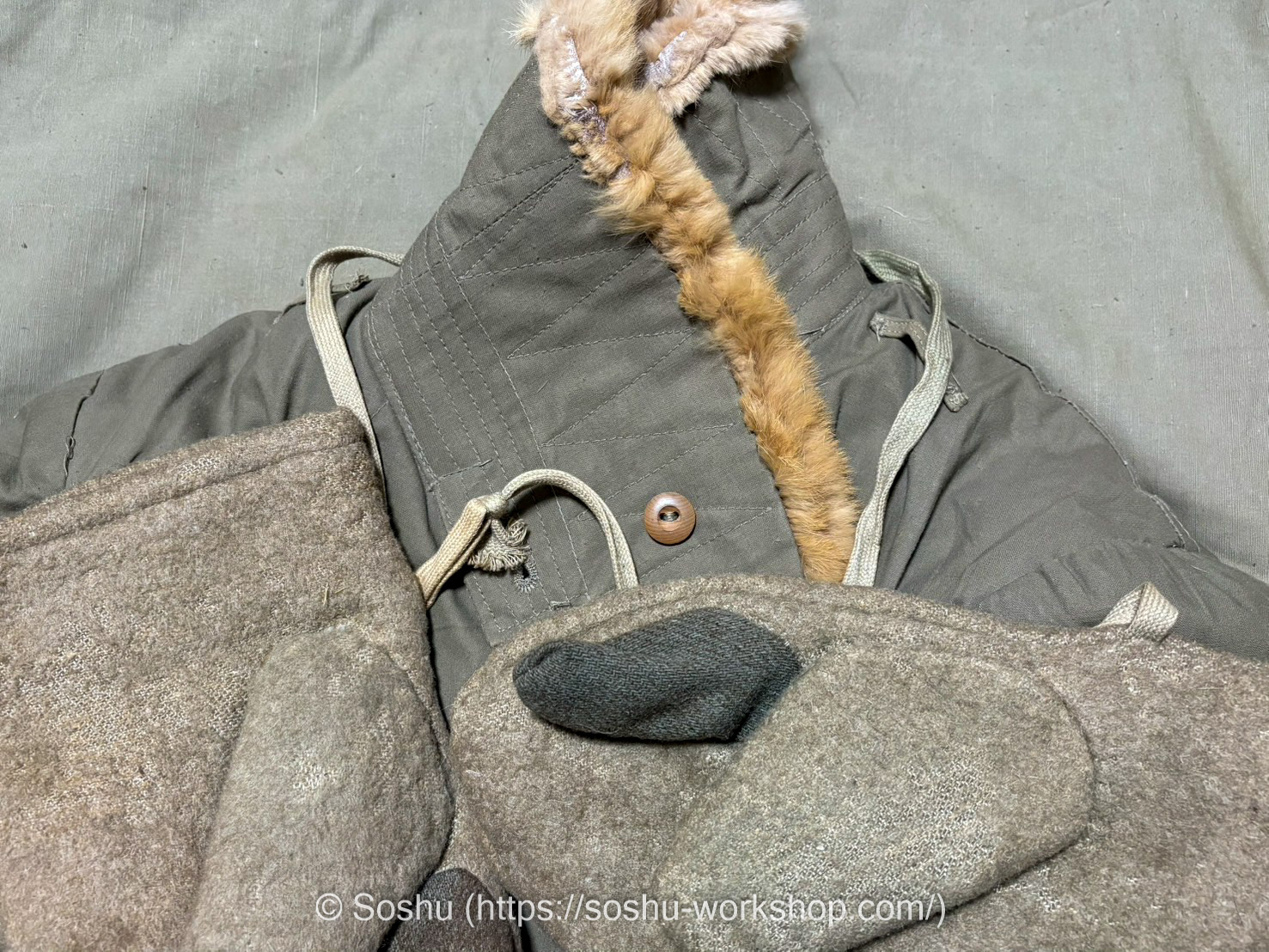
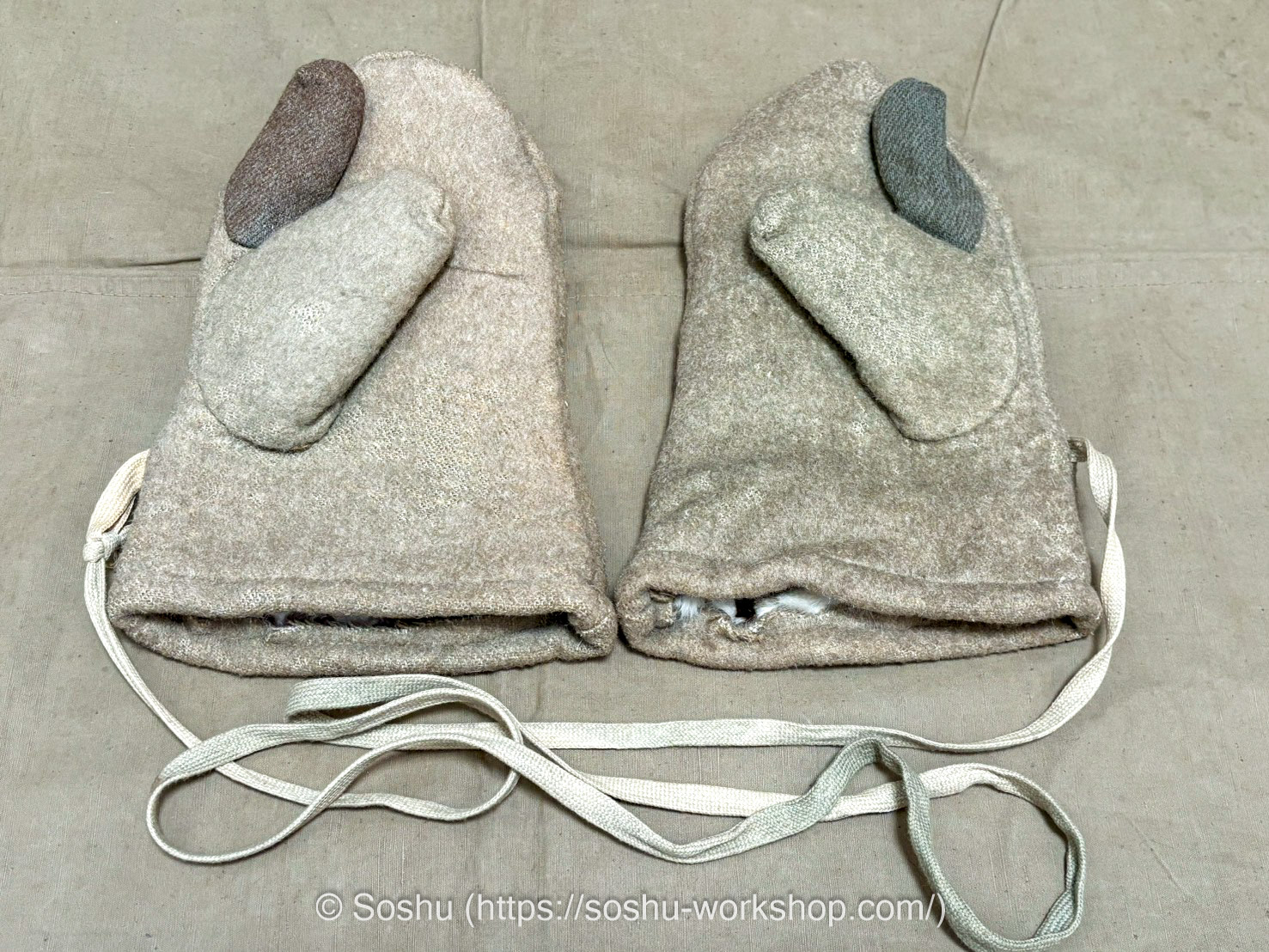
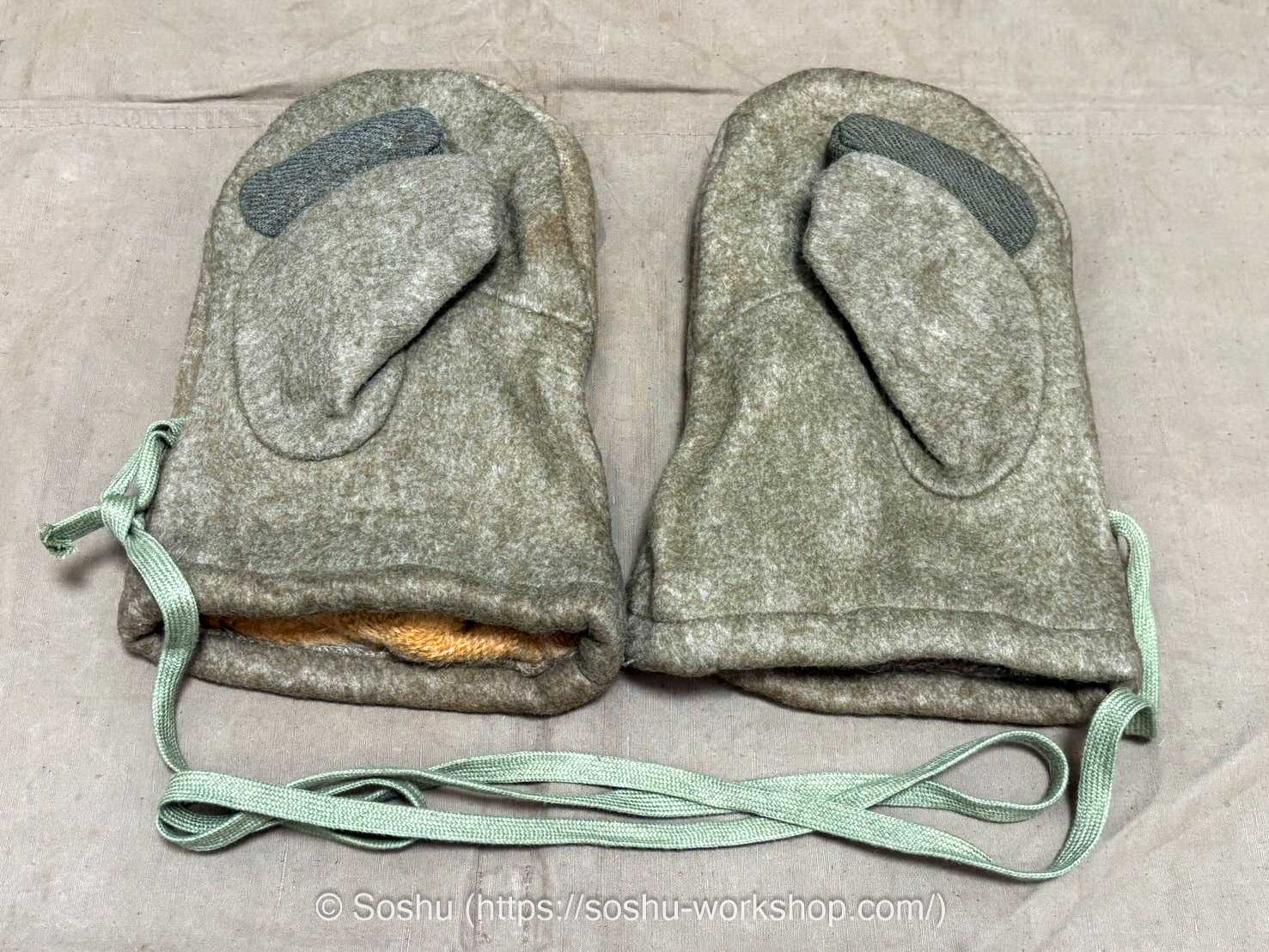
The overall body of the Cold Weather Mittens is made of thick, woolen cloth similar to heavy broadcloth. The fabric is quite dense and offers excellent insulation, but it does not allow the fingers to bend very flexibly. In contrast, the index finger section is made of a cotton-based fabric. It is somewhat thinner and more flexible, allowing for comparatively finer movements.
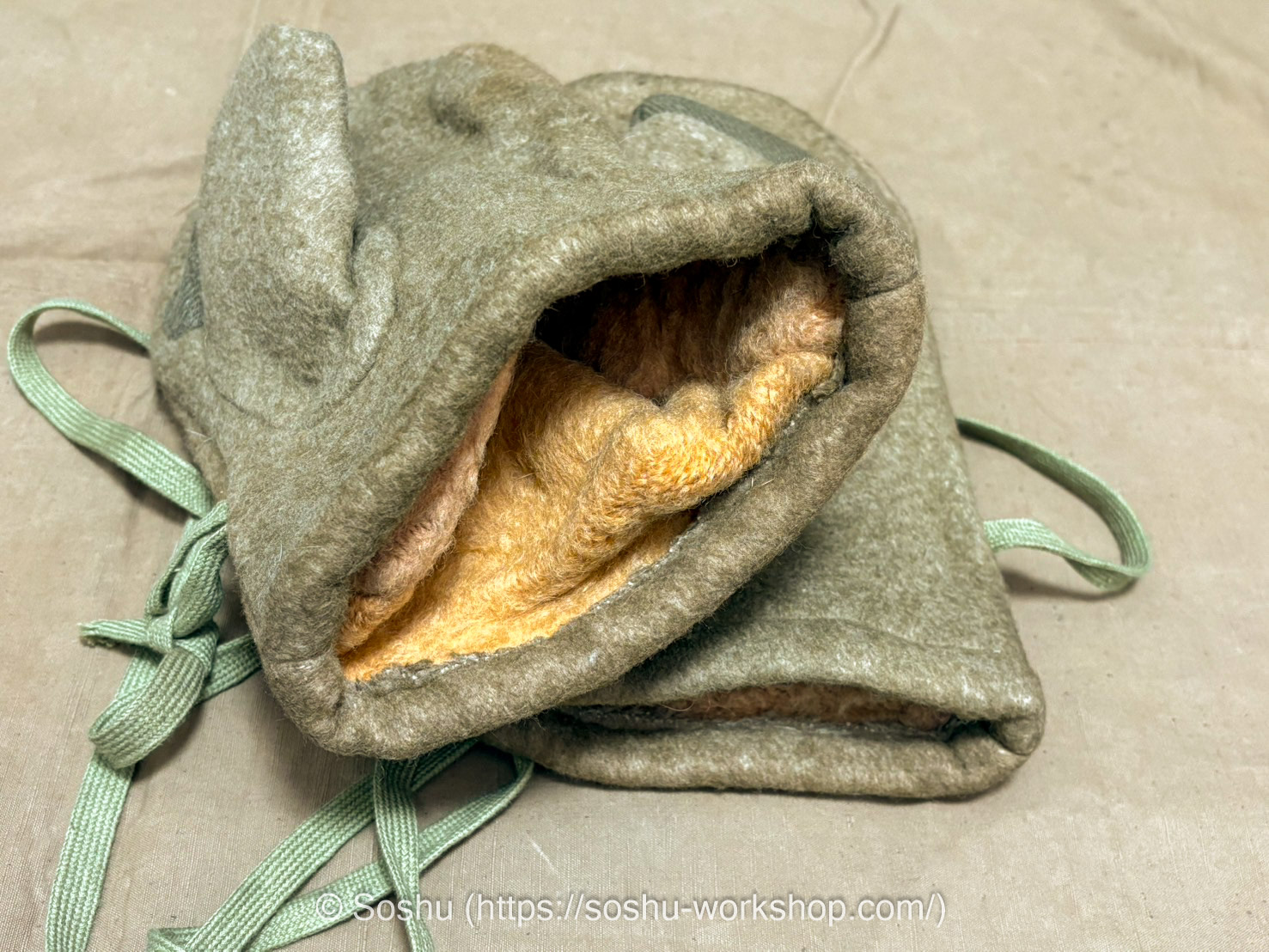
In the example shown below, the color of the index finger section differs between the left and right gloves. It is unclear whether this is due to aging and discoloration over time or an original manufacturing variation. The interior is lined with fur.
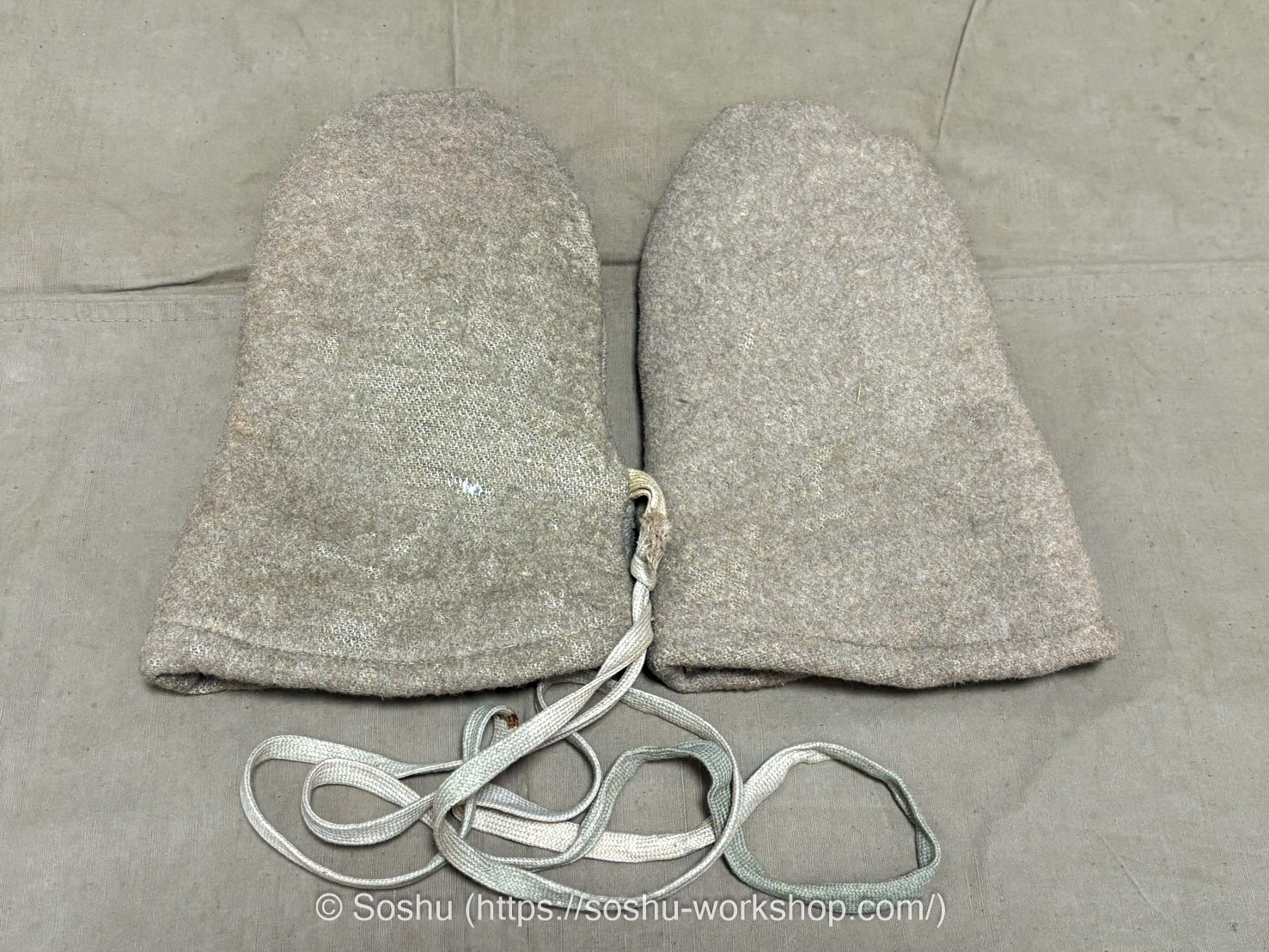
This example has an overall strong greenish tone. The interior is lined with bright orange artificial fur.
The Cold Weather Mittens were in fact intended for use in environments below –10°C. In less severe cold conditions, wool knit gloves (made of wool jersey) were typically used instead.
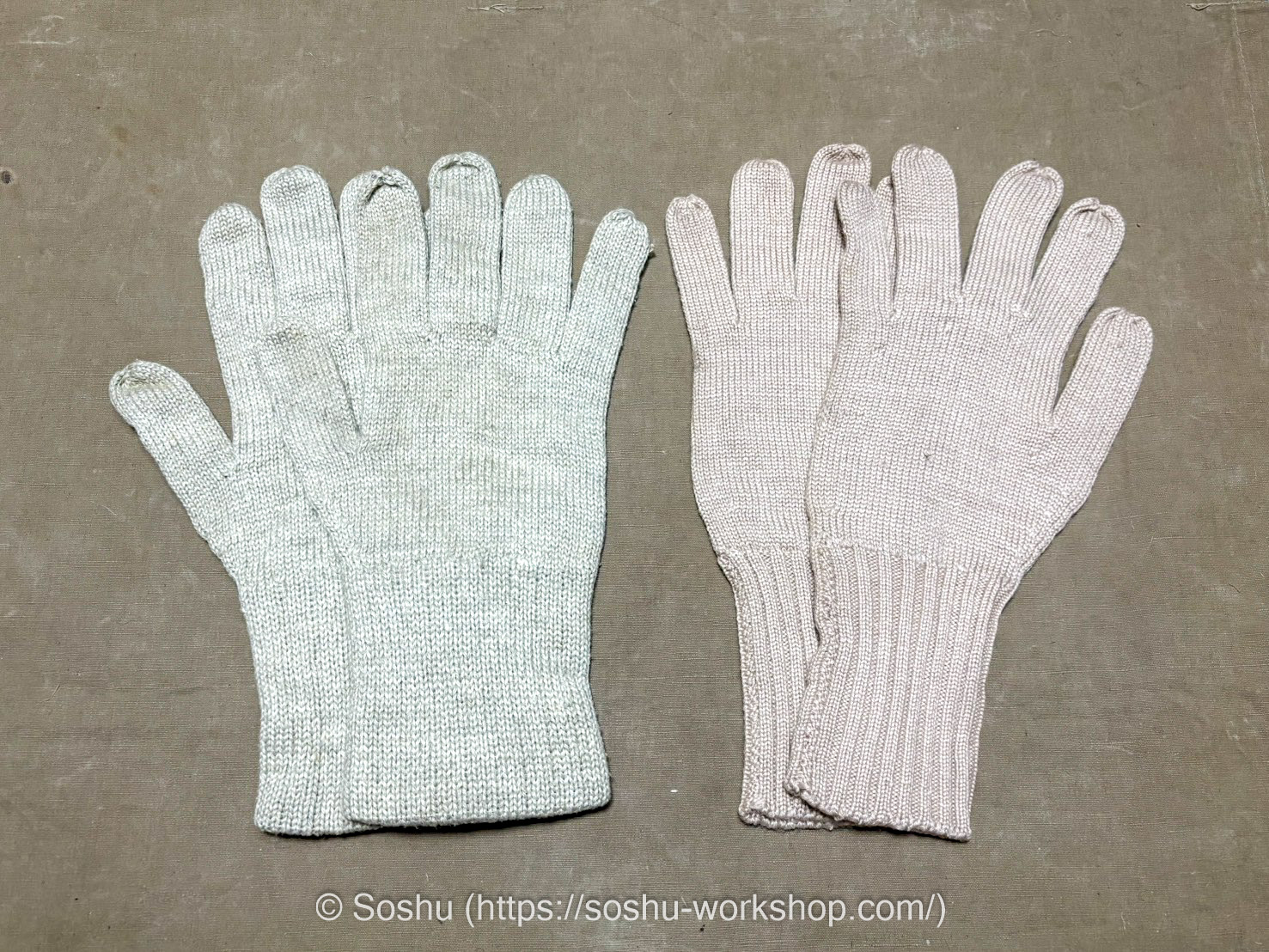
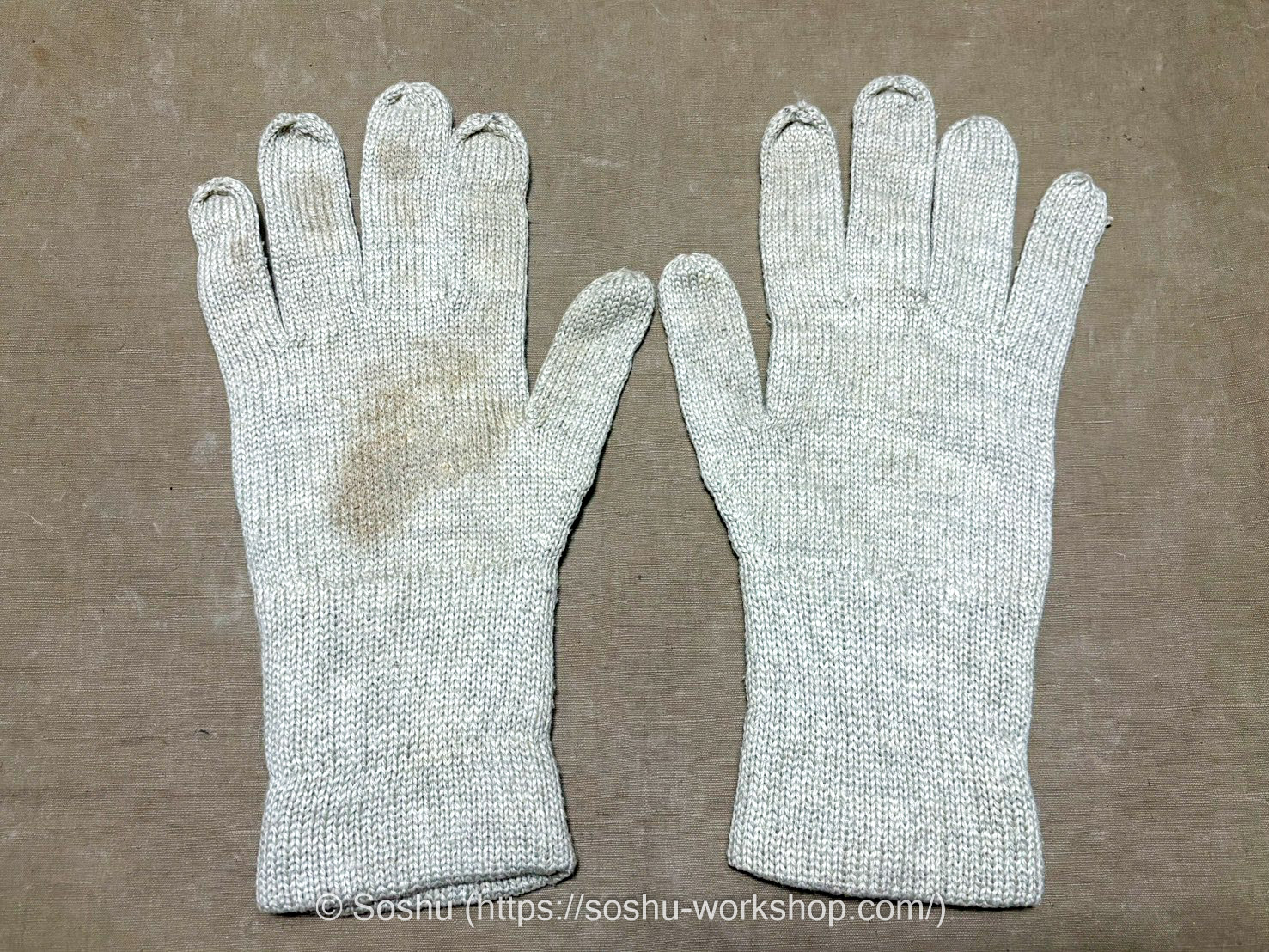
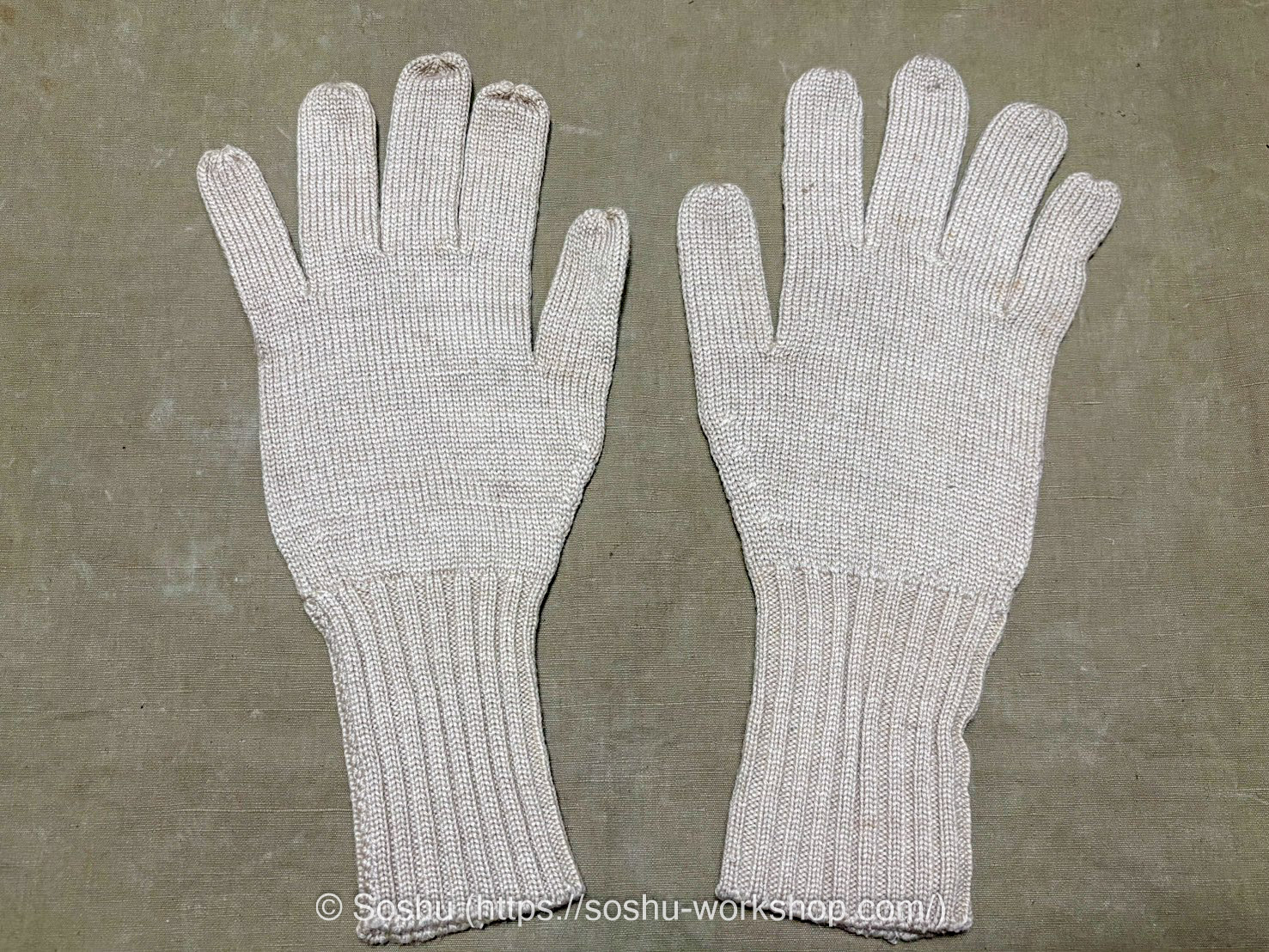
When wearing the Cold Weather Mittens, an additional pair of inner Cold Weather Gloves was worn underneath. Their shape resembles modern Japanese work gloves, but the fabric is thicker and more tightly woven, providing greater insulation. Another notable feature is the unusually long wrist section.
Before putting on the extreme Cold Weather Equipment introduced so far, soldiers would first wear items such as a Cold Weather Undershirt, Cold Weather Under Trousers, Cold Weather Gloves, and Cold Weather Socks. I also have a full set of these items and hope to introduce them at another time.
Footnote
- “Regarding the Regulations for Special Regional Clothing” JACAR (Japan Center for Asian Historical Records), Ref. C01001082500, Permanent Documents, Class A, Category 1, Showa 4 (National Institute for Defense Studies, Ministry of Defense) ↩︎
- “Revisions to the Army Uniform and Equipment Regulations under Article 5 of the Army Uniform Regulations” JACAR (Japan Center for Asian Historical Records) Ref. C01001561600, Eizonsyo Documents, Series A, Category 1, Shōwa 13 (1938) (National Institute for Defense Studies, Ministry of Defense) ↩︎